Start your free 3-day trial — no credit card required, full access included

Anatomy - Chimney technique for juxtarenal aortic aneurysm (Ch-EVAR)

  1. Abdominal aorta

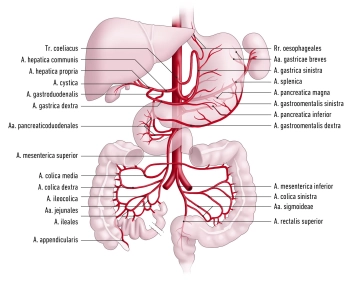
    Abdominal aorta
    Zum Vergrößern bitte anklicken

    Origin

    • from the thoracic aorta after its passage through the aortic hiatus of the diaphragm at the level of T12

    Course

    • retroperitoneal
    • left of the median plane ventral to the vertebral column
    • at the level of the umbilicus/L4 division (aortic bifurcation) into the common iliac arteries

    Branches from cranial to caudal

    • Inferior phrenic arteries
    • Celiac trunk
    • Middle suprarenal artery, right and left
    • Superior mesenteric artery
    • Right or left renal artery
    • Ovarian artery - or testicular artery, right and left
    • Lumbar arteries
    • Inferior mesenteric artery
    • Median sacral artery

    Supply area

    • paired branches: abdominal wall, paired retroperitoneal organs, gonads
    • unpaired branches: spleen, unpaired digestive organs
  2. Paired branches of the abdominal aorta

    Main branches

    Course

    Branches and their supply areas

    A. phrenica inferior

    • runs cranially on the underside of the diaphragm towards the diaphragmatic domes
    • network-like division into several terminal branches

    A. suprarenalis superior: Adrenal gland

    Terminal branches: Underside of the diaphragm

    A. suprarenalis media

    • runs laterally to the adrenal glands

    Terminal branches: Adrenal glands

    A. renalis

    • Origin approx. level L1 - 2
    • A. renalis dextra: runs dorsal to the V. cava inferior and pancreatic head to the right kidney
    • A. renalis sinistra: runs dorsal to the pancreatic body to the left kidney

    A. suprarenalis inferior: Adrenal gland

    A. ovarica,

    A. testicularis

    • Origin below the Aa. renales/L2 from the anterior side of the aorta
    • run over the psoas muscle, ureter and Aa. iliacae externae to the suspensory ligament of the ovary or to the deep inguinal ring of the inguinal canal and the testis

    Aa. ovaricae: Ovaries, parts of the uterine tube,

    Aa. testiculares: Testes, epididymis

    Aa. lumbales (4 on each side)

    • run laterally behind the psoas muscle over L1 – 4
    • Anastomoses with the arteries of the anterior abdominal wall (Aa. epigastricae superior and inferior, A. iliolumbalis, A. circumflexa ilium profunda)

    Rr. spinales: Spinal canal

    Terminal branches: Abdominal wall, back musculature

  3. Unpaired Branches of the Abdominal Aorta

    • All unpaired branches of the abdominal aorta form anastomoses that maintain organ perfusion via a collateral supply:
      • Truncus coeliacus -> Aa. gastroduodenalis -> A. mesenterica superior
      • A. mesenterica superior -> A. colica media und sinistra -> A. mesenterica inferior ("Riolan anastomosis")
      • A. mesenterica inferior -> A. rectalis superior und media -> A. iliaca interna
    1. Truncus coeliacus
    • Origin at the level of T12
    • divides into the A. splenica, A. gastrica sinistra, and A. hepatica communis (largest-calibre branch of the trunk)

    Main branches

    Course

    Branches and their course

    Supply area

    A. splenica

    • along the upper border of the pancreas
    • entry into the splenorenal ligament and spleen

    Rr. pancreatici:

    • dorsal to the pancreas

    A. pancreatica dorsalis:

    • dorsal to the pancreas
    • anastomoses with A. pancreatica magna to form A. pancreatica inferior

    A. pancreatica magna:

    • dorsal to the pancreatic tail, extending caudally
    • anastomoses with A. pancreatica dorsalis to form A. pancreatica inferior

    Pancreas

    A. gastrica posterior:

    • courses in the phrenicosplenic ligament cranially to the gastric fundus

    Stomach (posterior surface of the fundus)

    Aa. gastricae breves:

    • course in the gastrosplenic ligament to the gastric fundus

    Stomach (fundus and greater curvature)

    A. gastroomentalis sinistra:

    • courses in the gastrocolic ligament to the greater curvature
    • anastomoses with A. gastroomentalis dextra

    Stomach (fundus and greater curvature)

    A. gastrica sinistra

    • extends to the lesser gastric curvature
    • anastomoses with A. gastrica dextra

    direct branches

    Stomach (lesser curvature)

    Rr. oesophageales

    Oesophagus

    A. hepatica communis

    • courses rightward to the hepatic portal
    • Division into A. hepatica propria and A. gastroduodenalis

    A. hepatica propria

    • Main branch of A. hepatica communis
    • originates behind the pylorus
    • extends in the hepatoduodenal ligament together with V. portae hepatis and the common bile duct to the hepatic portal
    • gives off 3 branches:

    1. A. gastrica dextra:

    • courses in the lesser omentum to the lesser gastric curvature
    • anastomoses with A. gastrica sinistra

    Stomach (lesser curvature, right)

    2. A. hepatica dextra

    Liver (right part)

    Gallbladder (A. cystica)

    partial caudate lobe

    3. A. hepatica sinistra

    Liver (left part)

    partial caudate lobe

    A. gastroduodenalis

    • courses dorsal to the lesser omentum to the pancreas
    • divides into 2 branches:

    1. A. gastroomentalis dextra:

    • extends to the greater curvature
    • anastomoses with A. gastroomentalis sinistra

    Pancreas, duodenum, stomach

    2. A. pancreaticoduodenalis superior anterior and posterior:

    • together with branches of A. pancreaticoduodenalis inferior, form a vascular plexus around the pancreatic head
    2. Superior Mesenteric Artery
    • originates from the aorta at the level of L1–2
    • extends anteroinferiorly
    • Branches: A. pancreaticoduodenalis inferior, Aa. jejunales and Aa. ileales, A. ileocolica, A. colica dextra, A. colica media

    Main Branches

    Course

    Branches

    Supply Area

    A. pancreaticoduodenalis inferior

    • courses in the area of the pars horizontalis duodeni cranially to the pancreatic head

    R. anterior and posterior:

    • anastomose with A. pancreaticoduodenalis anterior and posterior

    Pancreatic head

    Aa. jejunales and Aa. ileales

    • course in the mesenteric root to the jejunum and ileum
    • form a vascular arcade among themselves

    Aa. rectae

    Jejunum, ileum

    A. ileocolica

    • courses in the mesentery to the ileocecal region

    A. caecalis anterior and posterior

    Caecum

    A. appendicularis (variant: origin from A. caecalis posterior)

    Appendix vermiformis

    A. colica dextra

    • courses in the ascending mesocolon to the ascending colon

    divides into 2 branches, which anastomose with A. colica media or A. ileocolica

    Ascending colon

    A. colica media

    • courses in the transverse mesocolon to the transverse colon

    divides into 2 branches: right branch anastomoses with A. colica dextra (right flexure), left branch anastomoses with A. colica sinistra (left flexure)

    Transverse colon

    3. Inferior mesenteric artery
    • originates at the level of L3 from the aorta
    • supplies the colon beyond the left flexure via A. colica sinistra, Aa. sigmoideae, and A. rectalis superior

    Main branches

    Course

    Branches

    Supply area

    A. colica sinistra

    • courses within the descending mesocolon to the descending colon

    divides into 2 branches, which anastomose with A. colica media and Aa. sigmoideae, respectively

    Descending colon

    Aa. sigmoideae

    • 2-4 arteries that form a vascular arcade in the sigmoid mesocolon
    • anastomose with A. colica sinistra and A. rectalis superior

    several small branches to the sigmoid colon

    Sigmoid colon

    A. rectalis superior

    • approaches the rectum from the dorsal aspect
    • anastomoses with A. rectalis media

    several small branches to the rectum

    Upper rectum

Arterial supply of the pelvis

The abdominal aorta divides at the aortic bifurcation (approx. level L4) into the two common iliac

Activate now and continue learning straight away.

Single Access

Activation of this course for 3 days.

US$9.27 inclusive VAT
Add to cart

Most popular offer

webop - Savings Flex

Combine our learning modules flexibly and save up to 50%.

from US$4.30 / module

US$51.61/ yearly payment

price overview

vascular surgery

Unlock all courses in this module.

US$8.60 / month

US$103.23 / yearly payment

Add to cart
to top