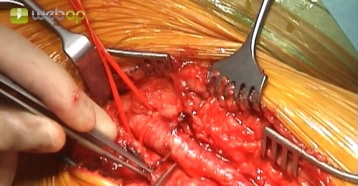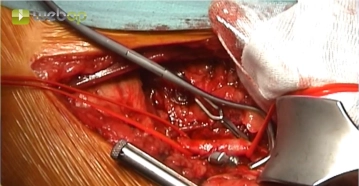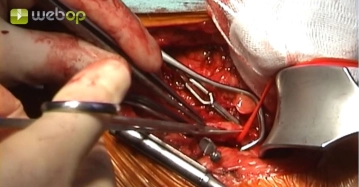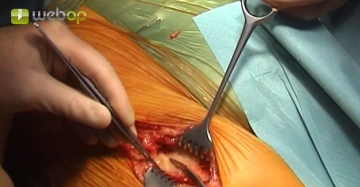
The longitudinal skin incision is made distal to the inguinal region on the proximal thigh, approximately 1 cm lateral to the palpable femoral artery. After transecting the subcutaneous tissue, the femoral fascia is incised longitudinally medial to the sartorius muscle. At the caudal edge of the incision, the fascia of the adductor canal is opened, the superficial femoral artery is exposed and encircled with a vessel loop. The lymph collectors crossing beneath the inguinal ligament are divided between Overholt clamps and secured with transfixion ligatures. The lymph nodes are enlarged due to PAOD Fontaine grade IV.
Tips:
1. Access lateral to the femoral artery spares the lymph collectors and permits subsequent offset layered closure with the aim of reliable wound healing.
2. The superficial femoral artery serves as a landmark for proximad dissection lateral to it. This helps to easily locate the deep and common femoral arteries and also avoids the risk of injury to the veins running medially.
3. Transfixion ligation of the lymph collectors helps, to a large extent, to prevent subsequent lymphatic cysts and fistulae. In PAOD grade IV, postoperative lymph collection in the groin not infrequently paves the way for deep wound infection with fatal consequences for the limb and possibly even for the patient's life.