The indication for invasive treatment of an abdominal aortic aneurysm (AAA) is fundamentally derived from weighing the individual rupture risk under the natural course against the operative risk. If the rupture risk under the natural course exceeds the individual operative risk, invasive treatment is generally indicated.
Classification of rupture risk
Factors | Low risk | Moderate risk | High risk |
|---|---|---|---|
Aneurysm diameter | < 5 cm | 5–6 cm | > 6 cm |
Growth rate per year | < 0.3 cm | 0.3–0.5 cm | > 0.5 cm |
Smoking/COPD | low | moderate | heavy |
Family history | none | occasionally | frequent |
Arterial hypertension | none | well controlled | unstable despite treatment |
Morphology | fusiform | saccular | outpouchings |
Sex | male | female |
Indication for surgery
Classification | Size | Wall | Clinical presentation | Indication for surgery |
|---|---|---|---|---|
asymptomatic infrarenal | > 5 cm ♂ > 4.5 cm ♀ | intact | none | elective |
asymptomatic suprarenal | > 6 cm | intact | none | elective |
symptomatic | irrespective | intact | spontaneous pain, tenderness of the abdomen, back or flank | urgent, within 24 h |
ruptured | irrespective | contained or free rupture | diffuse severe spontaneous pain/tenderness on palpation of the rigid abdomen, with/without haemorrhagic shock | emergency |
aortoduodenal fistula | intermittent vomiting, melaena | emergency | ||
aortocaval fistula | right heart failure, fistula murmurs, central cyanosis, simultaneous contrast enhancement of the aorta and inferior vena cava | emergency |
Two procedures are available for the surgical treatment of AAA:
- open replacement of the abdominal aorta with a straight or bifurcated graft (OAR, open aortic repair)
- endovascular implantation of a stent graft (EVAR, endovascular aortic repair)
Laparoscopic aneurysm surgery, usually combined with a mini-laparotomy, is of rather minor importance.
The following recommendations exist for selecting the procedure – OAR or EVAR:
OAR (trans-, retroperitoneal)
- normal life expectancy
- low surgical risk ("fitness")
- anatomy unsuitable for EVAR: landing zone, aneurysm neck (angle, length), iliac vessels (stenoses, elongation, kinking), thrombi, calcification
- Marfan and other connective tissue disorders
EVAR (standard graft, custom-made)
- previous abdominal surgery
- limited life expectancy
- high surgical risk
- anatomy suitable for EVAR (see above)
EVAR requires adequate iliac vessels for access, since the stent graft systems are often large-calibre. Atherosclerotically narrowed, tortuous and kinked, but also aneurysmally dilated iliac vessels are problematic.
In the long term, the endovascular aortic graft is associated with a higher complication rate than open aortic surgery.
The mortality risk for EVAR or OAR in an individual patient can be quickly calculated using the so-called BAR Score Calculator -> www.britishaneurysmrepairscore.com, which can be usefully employed in counselling patients about the risk of an elective procedure with EVAR or OAR.
Video example
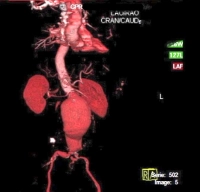
Asymptomatic, infrarenal AAA with a diameter of more than 5 cm, unsuitable for EVAR due to angulation of the aneurysm neck beyond 60°.